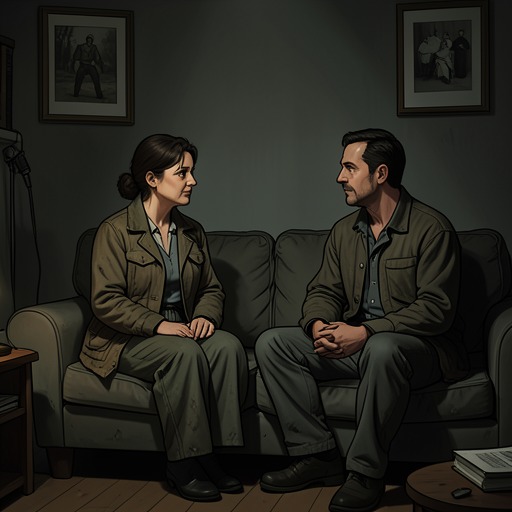
Asking Aham to come be with the family after her father’s death
Shrill: Notes from a Loud WomanAs Paul West Jr. lay dying, Lindy West and her family kept vigil through a slow, difficult wait. After his death on Monday afternoon, she called Ahamefule J. Oluo in Los Angeles and asked him to come. He did. The request did not restart their romance by declaration; instead, it brought him into the family’s immediate grief, where practical care and shared presence made a bond visible before either of them could define it.
The vigil and its ending
Paul West Jr. lost consciousness on Saturday night. Ingrid told West to go home and sleep, promising to call if it seemed he was about to die. West slept on her parents’ couch, having said goodbye and told him she loved him, and accepted that she might miss the end. In the morning, he was still holding on, so she returned. The family resumed its routine of chair, bench, and family lounge, sitting together through Sunday and into Monday as each breath grew slower and rougher. The vigil’s duration mattered: there was no single dramatic moment that could make the waiting bearable, only the repeated act of staying and listening.
Doctors came in with practiced concern and asked how the family was doing and whether there was anything they could do. Their questions collided with the room’s reality: West and her family had been sitting beside a man struggling to breathe for thirty-six hours, and the doctors had no remedy for the dying itself. The memoir holds together two opposing wishes. West wanted the purgatory of waiting to end, but also wanted it never to end, because its end would mean her father was gone.
On Monday afternoon, Paul West Jr. stopped breathing. West describes his body as fading to black-and-white, then seeming to flatten, as if the force that had held him in three dimensions had left. The image marks an abrupt change in what the body could mean: one moment it was the center of his personhood; the next, memory had to carry that role. The bluntness of that transition gives the later phone call its setting. West was not seeking to resolve a relationship in the abstract; she had just watched the person around whom her family had gathered become someone they could only remember.
The call from the family lounge
The immediate aftermath was stripped of ceremony. A nurse brought granola bars and juice boxes on a rolling cart; a man with a mop began preparing the room for its next patient, and someone with a clipboard started asking questions. Ingrid snapped that her husband had died thirty seconds earlier and asked for a minute. West and her family sat with the body, unsure what the point of staying with it was. The ordinary tasks arriving around the death made the family’s need for time especially stark.
West took her bereavement juice box to the family lounge and called Ahamefule J. Oluo in Los Angeles. Her request was simple: she asked him to come. He answered that he would. The juice box carries the scene’s strange scale: a small, institutional kindness accompanies a need that cannot be met by food or drink. The call turns that need outward, toward someone with whom West’s relationship had already become uncertain and painful.
The invitation did not mean that the couple had formally reconciled. They were not back together, and they were not sleeping together. Yet Ahamefule J. Oluo came and slept in the same bed, holding West as much as she needed. The distinction between a settled romantic commitment and the care she could ask of him remains explicit. His arrival answered the request without pretending that every difficulty between them had disappeared.
Care made practical
His support took the form of specific work as well as physical closeness. He ran errands for Ingrid and made her laugh. He cooked eggs Benedict, booked a piano player for the funeral, and worked out how to obtain a banquet license while West cried in a liquor store. These acts belong to the same period of mourning, but they are not interchangeable: he helped the family with daily needs, contributed to the funeral’s arrangements, and stayed with West through moments when grief interrupted even a practical errand.
The house filled with other people, too. West’s aunt and uncle came up from Arizona and stayed; Ahamefule J. Oluo’s daughters visited on weekends; friends and relatives dropped by nearly every day. In the little white house, people sat together, drank beer, and watched football. The gathering became a form of shared care, with no claim that grief had been solved or made orderly. Its busy, crowded quality recalled the kind of family life Ingrid had grown up with and loved, but which West, who had grown up alone, had not understood in the same way.
That contrast changes the meaning of the month in retrospect. West calls it the saddest month of her life, yet can also see a small vein of joy running through it. The joy does not cancel the death: it arises in the daily company that gathers around it, in the errands, the food, the visitors, and the people packed together in the house. Ahamefule J. Oluo’s presence is part of that wider, improvised family life rather than a substitute for it.
Kinship without a declaration
West and Ahamefule J. Oluo insisted that they were not getting back together; they swore they could not. Nevertheless, by the time West looked back, he had become her family. The event’s decisive change is therefore less a romantic reunion than a shift in what their relationship could hold. At a moment when West needed someone to come, he came, and the responsibilities he assumed placed him beside her family in practice even while the couple withheld the label of being together.
The relationship remained unresolved after the funeral. West and Ahamefule J. Oluo returned to Los Angeles and lived in limbo for a few months. He went on tour, and she began working at Jezebel. They still were not together, but they were happy in a way that felt unfamiliar. That continuation prevents the bereavement call from functioning as a simple reconciliation scene: it establishes closeness and kinship, while leaving the romantic question open. In the sequence of the memoir, the request made at the edge of death becomes the beginning of a different kind of togetherness, one first demonstrated through presence and care.